


Last Updated: October 28, 2026
Quick Summary
Preschool tracing worksheets build pencil grip and control better than letter tracing apps, which give instant feedback but often encourage swiping. Paper suits children who need handwriting practice, while apps suit shorter, feedback-driven sessions. The best choice depends on the child's age, attention span, and existing screen time.
- Paper tracing worksheets rate strong for pencil grip practice, while tracing apps rate weak.
- Apps give immediate feedback, but paper worksheets offer none.
- Paper worksheets are printed once, while apps often carry a subscription cost.
- Apps add to daily screen time, which paper tracing does not.
Table of Contents
- Preschool Tracing Worksheets vs Letter Tracing Apps: The Core Difference
- How Paper Tracing and Tracing Apps Compare on Handwriting Practice
- Free Printable Preschool Tracing Worksheets: Quality and Letter-Formation Checks
- Letter Tracing Apps for Kids: Screen Time, Privacy, Ads, and Subscriptions
- How to Teach Letter Formation at Each Age: Choosing by Development
- A Blended Practice Plan and Signs Your Child Is Ready to Move On
- Start Tracing Practice With The Happy Crab Play House Printables
- Frequently Asked Questions
Preschool Tracing Worksheets vs Letter Tracing Apps: The Core Difference
Preschool tracing worksheets give a child a printed letter to trace with a pencil, while letter tracing apps let a child trace on a tablet or phone with a finger or stylus. The Happy Crab Play House offers printable resources, created by an early childhood educator with more than 35 years of experience. Tracing worksheets are printed pages, and letter tracing apps are software that checks each stroke on screen.
The real difference is how each one teaches a child to hold and move a pencil. Paper asks a child to control a pencil on a surface that does not respond. Apps give instant feedback, but the child often swipes instead of writing. Most families who compare the two find that the better choice depends on age, attention span, and how much screen time is already in the day.
How Paper Tracing and Tracing Apps Compare on Handwriting Practice
| Factor | Paper Worksheets | Tracing Apps |
|---|---|---|
| Pencil grip practice | Strong | Weak |
| Immediate feedback | None | Strong |
| Screen time | None | Adds to daily total |
| Cost after purchase | Print once | Often subscription |
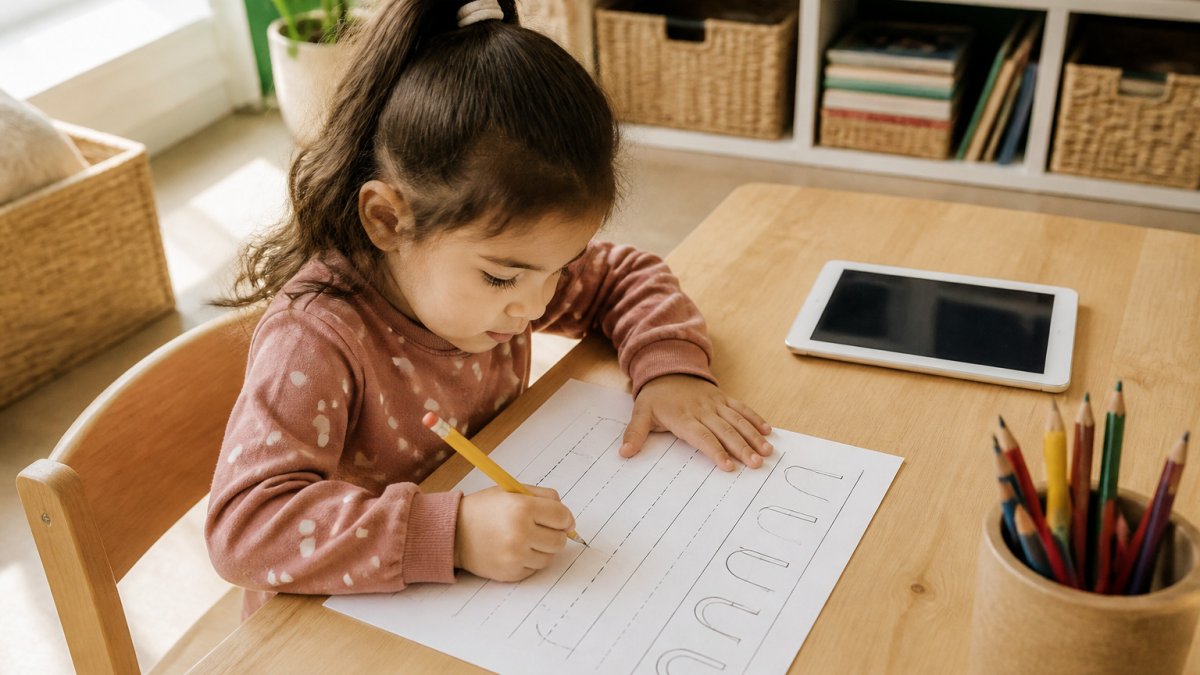
You can read more in our tracing worksheets guide for parents.
Free Printable Preschool Tracing Worksheets: Quality and Letter-Formation Checks
For ready-made printable options, you can explore the A-Z letter Tracing product, which covers each letter for ages 3 to 5 on one page.

Letter Tracing Apps for Kids: Screen Time, Privacy, Ads, and Subscriptions
For the paper side, see our tracing worksheets guide.
How to Teach Letter Formation at Each Age: Choosing by Development
For more on preparing for reading, see Help Your Child Get Ready to Read, and for recognition practice, see Printable Letter Recognition Worksheets for Preschool.
A Blended Practice Plan and Signs Your Child Is Ready to Move On
For more on preparing for reading, see Help Your Child Get Ready to Read, and for recognition practice, see Printable Letter Recognition Worksheets for Preschool.
Start Tracing Practice With The Happy Crab Play House Printables
The Happy Crab Play House offers printable tracing resources. The Tracing A to Z product is designed for paper practice, and Halloween Tracing Fun adds seasonal activities for preschoolers.

Frequently Asked Questions
Are tracing worksheets or letter tracing apps better for preschoolers?
Neither format wins on its own. Paper tracing builds pencil control and the real motor movements needed for writing, because the child grips a pencil and feels the paper resist. Letter tracing apps give immediate feedback and can hold attention for children who resist paper practice. Most families get the best results by using paper for handwriting and an app for occasional reinforcement, then checking progress by watching how the child actually writes letters on paper.
Do letter tracing apps help children learn handwriting?
Apps can support letter recognition and basic tracing, but they do not fully replicate the pencil grip, pressure control, and hand-eye coordination that handwriting depends on. A child who traces well on a touchscreen with a stylus may still struggle to write the same letter with a pencil. Use apps to introduce letter shapes and stroke order, then transfer that practice to paper to build true handwriting skill.
How can I teach a preschooler to hold a pencil and trace letters?
Start with a short, relaxed session of two to five minutes. Encourage a tripod grip with the thumb, index, and middle fingers on the pencil, and keep the wrist loose. Use thick, dark tracing lines on a printable page with a clear starting dot, and model one letter at a time while the child watches. Praise effort and accuracy, and stop before frustration builds.
Can children use both tracing worksheets and letter tracing apps?
Yes. A blended routine works well: paper tracing for two to three sessions a week to build pencil control, plus a short app session on other days to reinforce letter shapes. Keep app time brief, check that the app is offline-capable and ad-free if possible, and always return to paper before the child is expected to write letters independently.


